Southwell and the Three Fs
MOST senior racecourse executives thumb through the operating manual from A to Z. In the case of Southwell, executive director Mark Clayton seems to have been stuck on the letter F since he arrived at the Nottinghamshire track from Doncaster in February 2014.
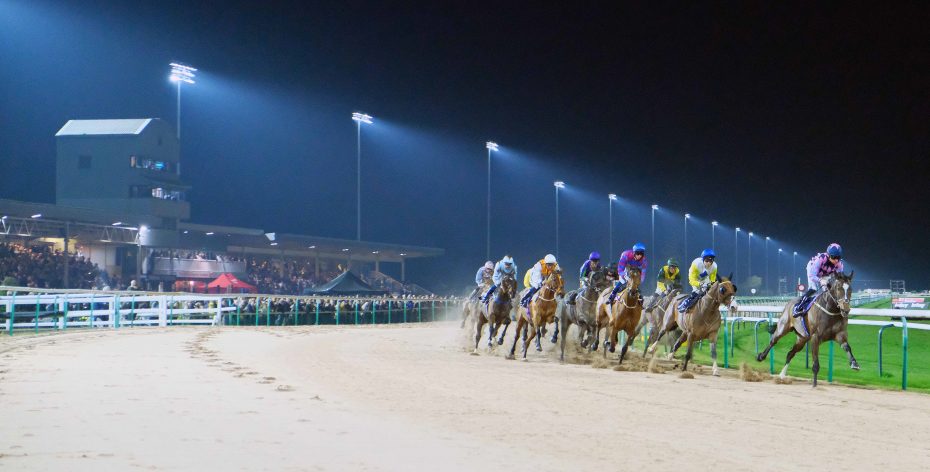
Southwell Racecourse shines under the new floodlight system
“It’s true,” he says, with a wry smile. “We’ve gone from flood defences to floodlights to fixtures in a very short space of time.”
The issue of flooding pre-dates Clayton’s appointment, but it was not long before he was thrown headlong into dealing with the full force of nature.
“In 2009 and 2012 the floods washed away about two-thirds of the Fibresand surface and rose to a height of about a metre around the site,” he recalls. “It devastated the racecourse and forced periods of closure, so it was obvious there was a need to address the situation.
“Before I arrived, there had been attempts at the first phase of what’s technically called bunding but it had never been fully designed, so it was a fast learning curve for me. I probably know more now about flood schemes than the average racecourse manager.”
The problem was caused by the River Greet, a tributary of the Trent which runs at the back of the racecourse, bursting its banks about a quarter of a mile from the five-furlong chute.
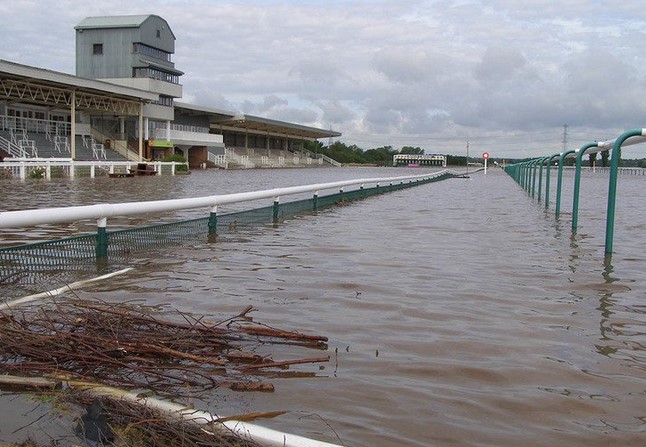
The floods from the River Greet were a major issue for the track (Image credit Pitchcare)
“After gaining planning permission we installed a 4km clay keystone bund around the site. The system was put in by Ardent, a London-based company of consulting engineers, and the work was carried out by a local firm AV Squires, who actually laid our Fibresand surface 30 years ago. It addressed and improved a series of ditches and dykes, which helped divert water around the system into flood cells on our land, slowly releasing water back into the local waterways but at no detriment to our neighbours.
“The system, which was completed in December 2017, had its first big test in June this year, when we had up to 30mm of rain in a very short period. The river did burst its banks in the usual place but the scheme coped as it was designed to do.”
Even before the flood alleviation scheme had become fully operational Southwell’s owner, Arena Racing Company, was working on the next stage of development, and planning consent for a floodlighting system was given in October 2017, with construction beginning the following June.
Clayton says: “Getting Southwell protected to a one-in-100-year flood occurrence made the group think about what else could be done, and the obvious answer was to increase our fixture list. In 2013 we had a peak of 77 scheduled fixtures but by 2018 that was down to 53. The answer was floodlights, which ARC already had at Wolverhampton and by that point were going through the process of installing them at Newcastle.
“It was a big investment, but the credit for being the driving forces must go to Stephen Higgins, the group’s estates director at the time, and chief executive Martin Cruddace, who ran with it.
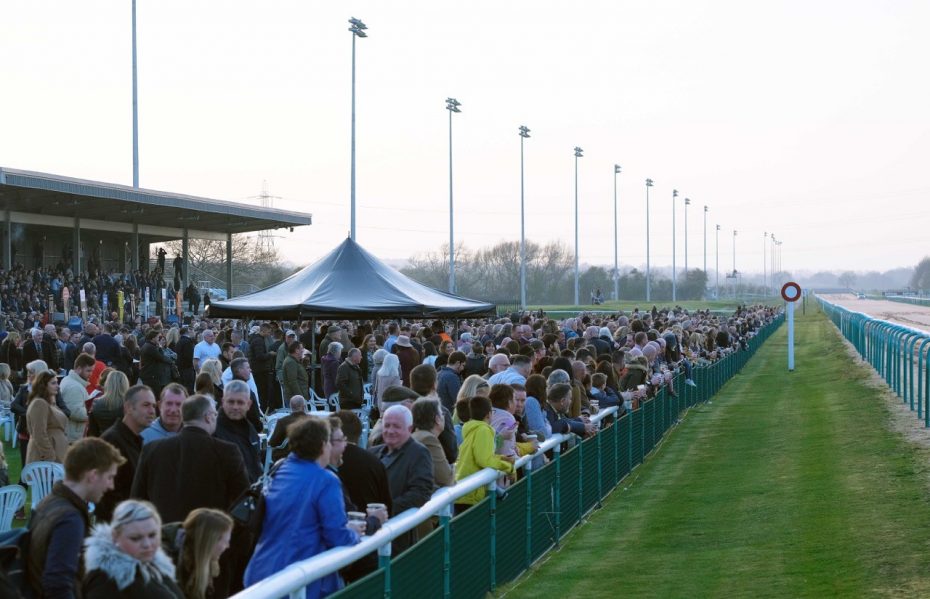
Crowds flocked to Southwell for the opening fixture under floodlights
“We used the same design team and contractors who were responsible for Newcastle, so we learned lessons from there and, much earlier, from Wolverhampton, which was a first-generation lighting system. Things have moved on a lot since then and we’re third generation.
“According to Musco, the American-based company who recently installed lights at Wimbledon for the tennis, Tottenham Hotspur and Twickenham and were responsible for the installation, they reckon it’s the best system of any racecourse in the world, and I wouldn’t disagree with them.
“Like the flood alleviation scheme, putting in floodlights was a massive exercise, and part of each project was undertaken during the winter months. Doing large groundworks during those periods is fraught with danger but we got through them both.
“We trialled the lights for the BHA on 7 March this year and got congratulations from everyone involved for a system that’s second to none.
“Our first floodlit racing went under the media radar because it was during the Cheltenham Festival, but we highlighted our official opening on Saturday 30 March, and with free entry for the locals, who we wanted to get on board from the start, there was a crowd of around 4,500, which would probably be Southwell’s largest-ever attendance.
“I’m proud as punch that we’re at the forefront of lighting technology in British racing. The system is efficient on consumption and there’s limited, if any, shadows. It’s a pure white light that’s instantaneous. Having minimal light spill was key for us because being in such a rural location we had to bear our neighbours in mind.”
Adding floodlights to the mix enabled ARC’s group racing team to make the anticipated case for more fixtures, and the scheduled number rose by 15, to 68, for this year and at the moment is programmed to be only three fewer in 2020.
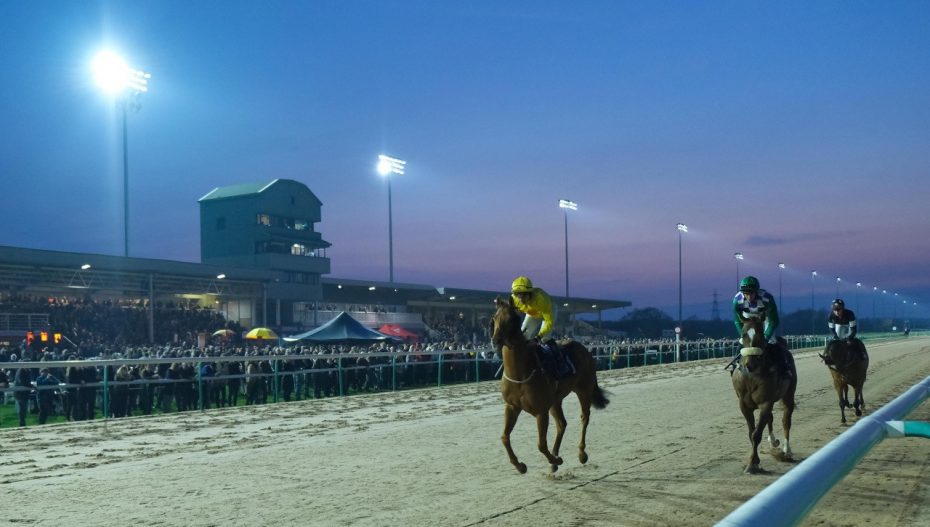
The provision of floodlights have enabled a host of new fixtures at the track
Clayton says: “There are now more all-weather tracks taking out of the fixture pot, but with the installation of floodlights we have regained much of the ground we lost.
“Our business at Southwell is based around volume of fixtures and racing as frequently as possible. Although we’ve got a good amount of outdoor event space, we’re not set up for large conferences and exhibitions and it’s very difficult to dovetail the volume of fixtures we have in the winter months with events.”
Southwell’s next priority is to celebrate the 30th anniversary of all-weather racing at the track. It all began at 1.10pm on 1st November 1989, with Martin Pipe making racing history by winning the Esso Tigers Novice Hurdle with 11/8f Zulu. The first winner on the AW level was a young Italian rider named Frankie Dettori—whatever happened to him?
Their exploits will be celebrated at an anniversary dinner on 8th November, followed 24 hours later by an Irish-themed race meeting that will feature a parade of Southwell champions.