British racing invests in state-of-the-art life size horse mannequins to aid welfare
British racing’s Horse Welfare Board, in partnership with the Racecourse Association (RCA), have led an investment in ten life-size, fully articulating training mannequins to support the welfare of horses.
The mannequins will be used on Britain’s racecourses to provide enhanced training of to veterinary and medical teams in the safe and timely movement of horses on course.
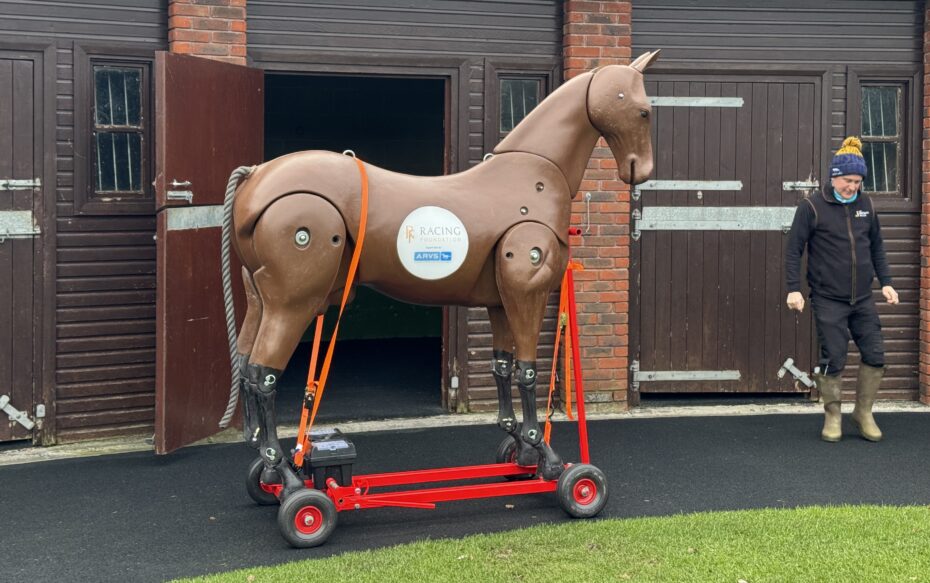
An investment of £50k from the Racing Foundation, with additional support of £15.5k from the Association of Racecourse Veterinary Surgeons (ARVS) has allowed the sport to purchase the mannequins from specialist manufacturer, Resquip, to facilitate better understanding, safety and welfare in the moving of horses on the racecourse. The models are meticulously designed to match the weight distribution and joint articulation of a horse, which can be as heavy as 600kg.
The mannequins will be strategically located at 10 of Britain’s 59 racecourses, to ensure all courses have access to them. An enhanced training plan will be rolled out by the RCA to facilitate hands on scenario planning and ‘moulage’ using the new equipment. 500 vets and medical personnel including doctors and nurses will have received enhanced training using the mannequins within 12 months as part of mandatory training guidelines set by British racing. In
addition to this, the mannequins will be used to support the training of Point-to-Point teams around the country as early as this Spring.
“Incidences that require the safe and timely movement of racehorses on course are rare. Nevertheless, the opportunity to be able to practice realistic full-scale scenarios in a controlled environment is a fantastic step forward. Managing a fallen horse can be complex and challenging, as well as emotive for the team, so the better prepared we are, the better the outcome.”
Barry Johnson, Independent Chair, Horse Welfare Board said: “The training will include ‘moulage’, a technique used to simulate injury, disease, ageing and other physical characteristics specific to a scenario, often used in human health and emergency worker training. This simulation-based training applied to the mannequins allows those involved in equine care to practice skills, decision-making, and critical thinking in a safe, supervised environment. It also supports training for the prompt and appropriate care of jockeys if trapped under a horse involving the on-course medical teams and service providers.”
Caroline Davies, Racecourse Services Director, Racecourse Association (RCA) said: “I welcome this investment which will support and enhance the significant ongoing work at British racecourses to ensure that fallen horses are supported as best as possible on race days, alongside any jockeys involved. We look forward to facilitating the roll-out and training programme to those involved in the care of our fantastic horses.”
Simon Knapp is a senior veterinary surgeon at Ascot, Kempton Park, Sandown Park and Epsom Downs, veterinary advisor to the Racecourse Association (RCA) and member of British racing’s Horse Welfare Board, said: “Following on from the one-off training events that took place last year, we felt that continuous access to this equipment would improve the training that racecourse teams receive, in both the frequency and realism of that training. In addition, equine vets support the wider horse population in clinical practice, so the enhanced knowledge that this training provides will, in the longer-term, benefit the entire horse population.”
Tansy Challis, Chief Executive of the Racing Foundation, said: “The Racing Foundation is pleased to support this important project, which forms part of our multi-year funding commitment to the Horse Welfare Board of £3million over a three-year period. With a number of stakeholders working together in its delivery, this project exemplifies the power of collaboration across the racing industry to ensure the highest standards of horse welfare.”
Reducing falls and improving safety is a key strategic priority of British racing. A number of safety improvements have been delivered as a result of the sport’s five-year welfare strategy ‘A Life Well Lived’. These include the changing the colour of obstacle markings from orange to white to improve clarity for horses, a new specification for hurdles and the phasing out of traditional birch hurdles by the sport.
Since 2000, £56m has been invested by the Horserace Betting Levy Board (HBLB) and the Racing Foundation, two major funders within the sport, into equine welfare projects.
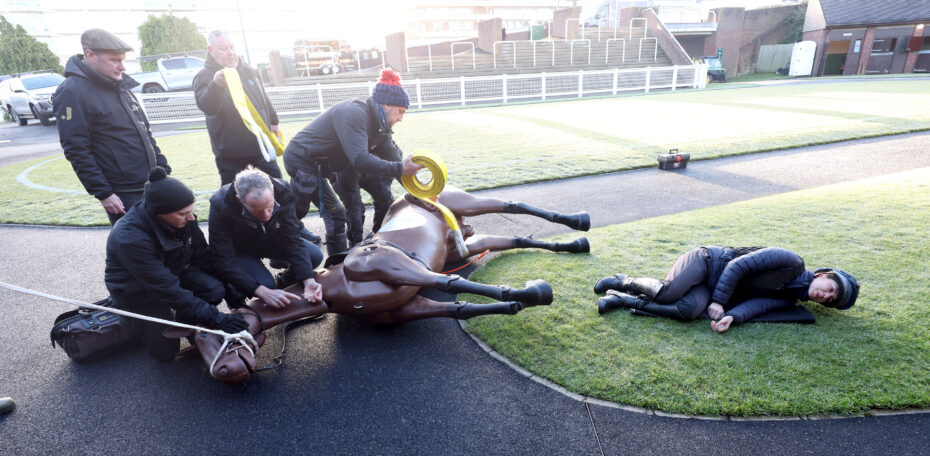
Cheltenham Racecourse received the first mannequin on 20th January 2025, with a further 9 racecourses set to obtain the equipment by 31st March 2025 as they come out of production.
Once the racecourse roll-out is complete, the sport will look to incorporate the mannequins into further ‘off-course’ training such as on training gallops. As part of the support, the Association of Racecourse Veterinary Surgeons (ARVS) will also utilize the mannequins for enhanced training and scenario management around the mandatory racecourse training programme.
For more information on British racing’s work to improve safety, minimize risk and continuously improve welfare standards for the horses that power our sport, please visit www.horsepwr.co.uk