Explainer: What’s the process before a fixture is cancelled due to weather?
As the annual cold snap has caused a number of fixtures to be cancelled, how do racecourses come to this decision?
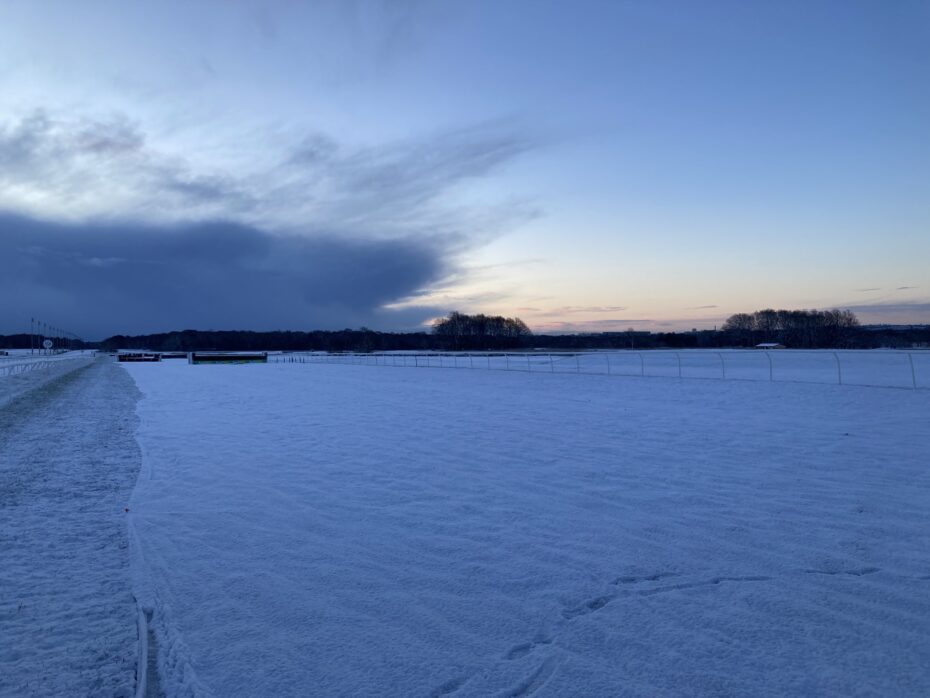
Newcastle Racecourse covered in snow in 2023 (image courtesy Newcastle Racecourse)
All involved with British horseracing, from participants to fans, want to see the programmed fixture list fulfilled. As such, it is codified in the BHA General Instructions, and accepted industry practise, that every effort should be taken to fulfil a fixture.
The decision to cancel is never taken lightly and, should it be required, is done so with the safety of humans and equines firmly in mind. The methodology behind abandoning is multi-layered and is directed to us by cross-industry agreed protocol, which recognises that there can be unique circumstances behind each abandonment. In such circumstances, it is difficult to achieve genuine standardisation across all racecourses.
Ahead of every fixture and routinely throughout the year, racecourses prepare a safe racing surface and updates of this are well documented via the Going App, Weatherbys and social media. Prior to each fixture, racecourse staff extensively consult detailed weather reports and many will access localised weather stations to get the most realstic understanding of expected conditions. If, during this time, it is apparent that there is cause for concern that racing may be in jeopardy due to inclement weather or unsafe ground, this will be logged by the Clerk of the Course who may choose to undertake an inspection.
This inspection is led by the Clerk of the Course and they will take initial counsel from their grounds team. This group of people work daily at the racecourse and have extensive knowledge of the racing surface and its reaction to the local climate.
In the RCA’s guidance to racecourses on this subject, we encourage them to invite a raceday steward to be part of this inspection where their experience and knowledge is considered to be beneficial. Further counsel may be obtained from the Racecourse Director or a Director of the Company, and many racecourses will seek further views from trainers and other participants in close proximity to the track.
Clerks of the Course and groundstaff are highly experienced and skilled practitioners. The requirements to become a qualified Clerk of the Course are extensive, and include an examination and interview by a panel comprised of senior industry stakeholders plus many hours of observed working time. They are the most qualified individual to take this decision ahead of the scheduled raceday.
From approximately two hours prior to racing, the raceday stewards can convene an Inspection Panel to determine whether, given the circumstances and prevailing conditions, the racing surface is fit to run.

Ground staff at Hereford Racecourse lay frost covers over the racing surface (image courtesy Hereford Racecourse)
The Panel will always include a representative from: the raceday stewards, the racecourse, a trainer, a jockey and the medical/veterinary teams. This Panel may also be supplemented with any other individuals that may be able to offer further evidence to aid the decision.
The Inspection Panel will be tasked with reviewing the situation and providing their objective thoughts as guided by a set decision-making chart for the raceday stewards to then make the overall decision.