Jumping Forward- the Padded Hurdle
HEATH ROBINSON, the early 20th Century cartoonist and illustrator whose complex and implausible drawings of machines that achieved simple objectives gave his name to the post-war needs of ‘make do and mend’, has an equivalent in British racing. Richard Linley, the BHA’s senior inspector of racecourses, is a one-man research and development operation, at least as far as padded hurdles are concerned.

“Yes, I am a bit of a Heath Robinson character,” he admits. “I like tinkering, and I get reprimanded now and again for never throwing away things from the garage, just because I might need them.”
Linley’s garage became the workshop in which he formulated his idea for a padded hurdle, as an alternative to the traditional wooden-framed, birch-filled obstacles over which he gained his biggest win as a jockey on Gaye Brief in the Champion Hurdle.
“When I first started riding, the old-style hurdle had no take-off board and very little padding, and they were 40 inches in height and fairly upright,” he recalls. “Looking at pictures of Persian War winning the Champion Hurdle in the late 1960s, we’d have a war on our hands if we produced the same hurdles nowadays.

Richard Linley – Inspector of courses. Photo courtesy of Dan Abraham.
“The two significant changes before I retired from riding in 1987 were the introductions of the take-off board in 1980, which seemed a natural progression to help a horse with its stride pattern, and a uniform height of 38 inches, which reduced the angle of the hurdle by seven degrees.
“Post-retiring, the most important change came in 2000, when gorse was outlawed from hurdles. It was horrendous stuff to deal with. There was so much material in the hurdles that it used to take four men to lift one flight, but there was also a horse welfare issue, because as soon as a horse came back from the races, stable staff would have to check there was no gorse left in the limbs that might cause infection.”
Welfare, of horses, riders and groundstaff, was at the heart of Linley’s search for a suitable alternative.
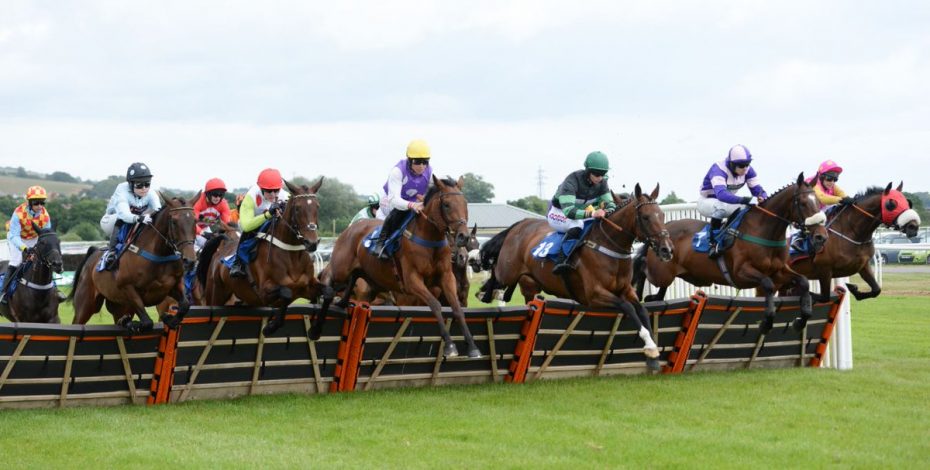
Image courtesy of Fiona Crawford
“Principally the idea was to minimise risk,” he explains. “There will always be risks in jump racing but If you can reduce them and prolong the sporting life, whether for horses or people, that has to be a good thing. And if as a consequence of minimising risk, there are fewer falls, that too has to be good.
“Secondly, the intention was to improve the working lives of groundstaff. Particularly on a summer jumping course, they are under a lot of pressure, so it was important not to produce something that would increase their workload.”
Enter Heath Robinson. “There were a lot of experiments and I started the first ones for my own satisfaction, because I thought we could better than what we were doing at the time,” Linley says. However, his first prototype hardly got off the ground. Using artificial Scots pine produced a hurdle that cost around £500 and weighed 80kg, compared with the traditional birch variety of 38kg.
“That was hernia country for me, working on my own!” he recalls, with feeling. “So, in 2008 I found a company in Trowbridge called Airofreem, which produced a much more suitable material using smooth, close-cell foam and could make a hurdle that weighed around 25kg.”
After a year of development and a year of taking the padded hurdle to several yards and on to the gallops at Lambourn and Malton, Linley’s enthusiasm hit a brick wall of opposition from trainers. “It’s a little like everything new; the Brits don’t like change,” he says. “I was so deflated.”
However, Linley ploughed on, and having persuaded the jockeys to accept a trial run he found a willing racecourse in Newton Abbot, where managing director Pat Masterson was quick to see the potential, as well as the risk.
Masterson recalls: “Newton Abbot hosts a summer jumping programme with safe, fast ground. In some quarters it’s inevitable we will receive questions about any injuries that occur, but I was uncomfortable seeing our racecourse mentioned with such frequency about serious injuries. My No. 1 priority was to try and take Newton Abbot away from this conversation, and the welfare of the horse was paramount in any decision we made.

Newton Abbot Managing Director Pat Masterson
“Having looked at the new hurdles and their cost, we decided the biggest risk was that we were taking a huge punt on something that was not used anywhere else, and if it went wrong, it could have ruined our reputation.”
It did not go wrong. Starting in March 2013 with one set of hurdles in the chute for 2m 3f races, the whole circuit of five flights was completed in June that year.
“We took opinions from the jockeys and the vets,” Masterson says. “There was a difference of opinion among some jockeys. Naturally some didn’t like change; others wanted them on more racecourses, to provide continuity, but we worked really hard over the first few years and saw the benefits straight away.
“Apart from the main priority, the welfare of the horse, it also became apparent that it was going to cost us less in breakages, because the top bars of the traditional hurdles used to break, and staff would repair them ready for the next meeting or you had to buy more.
“All round they cost less in staff time, which means groundstaff can do other things. It’s a win-win for us, and a win-win for the industry.”
Taunton doubled the padded-hurdle brigade a year after Newton Abbot, and since 2016 Bangor, Cartmel, Exeter, Kelso, Stratford and Uttoxeter have joined the fray.
Linley is pleased with the outcomes. “With fatal and long-term injuries, it’s always difficult to establish the exact cause of one or the other,” he says. “However, all the vets and the racecourses involved have told me that in terms of superficial injuries which keep horses away from the racecourse for up to three weeks, the padded hurdles have gone some way to reducing the numbers quite significantly.
“In addition, I’m encouraged by the faller rates on courses with padded hurdles compared with the ten-year average, although it’s only a relatively small sample.
“People have embraced the change better in recent years and are more receptive to their courses coming on stream.
“It was quite tough to start with, but people can now see the results in terms of reducing superficial injuries, and it’s to everybody’s benefit that horses leave any racecourse as fit as possible to come back in the future.”
Masterson adds: “Our faller rate has improved, but equally as important there are a lot more horses that are pulled up. You have to jump these hurdles; it’s not a case of a horse crashing through them on the second or third circuits. The jockeys seem to be much more respectful of these obstacles, so they’re more willing to pull up tired horses, which is good from a welfare point of view.
“Every racecourse is championing the welfare of the horse, but if at the same time we can save money, that’s a bonus that can be spent elsewhere.
“Ever since day one we’ve been trying to champion these hurdles, trying to get more racecourses to come on board. So far, only small racecourses are using them. We’re waiting for a big racecourse to look at the statistics and come aboard.”
He may not have to wait long for his wish to be fulfilled.