Open for All at Ascot Racecourse
Racecourse initiatives have their foundation in a wide variety of sources, and many are increasingly emanating from outside the sport. The introduction at Ascot this year of a sunflower lanyard for people with a hidden disability owes much to a visit that Jo Wales, head of operations, paid to Gatwick airport.

Ascot’s sunflower lawn is extensively promoted on the racecourse website
She explains: “George Vaughan, our head of technology, is very good at seeing what’s happening in other arenas, and he knew that I felt strongly about wanting to elevate accessibility at Ascot, so he took me on a tour of Gatwick with Sara Marchant, their access officer, who’s now working at Heathrow.
“She took us round all the initiatives they had put in place at the airport, and for me the one that really stood out was the accessibility lanyard.”
The Racecourse Association has been developing a similar project throughout the second half of 2019 to offer all racecourses the opportunity to roll out the sunflower lanyard initiative. RCA Brand & Experience Manager Paul Swain presented a review of research conducted which included best practice from Marchant at Heathrow Airport, Sainsbury’s and LNER.
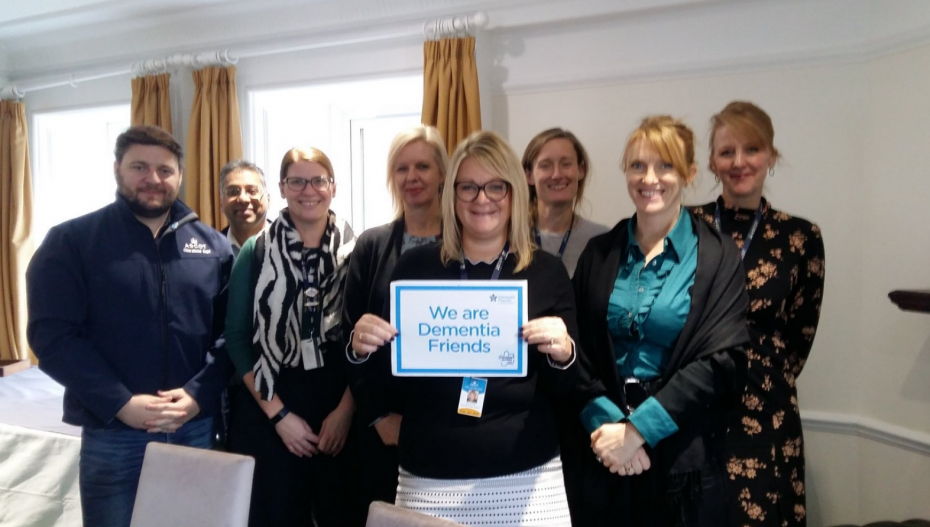
Jo Wales and her team have successfully completed the dementia friends training (image credit @NoviceFilly)
Ascot works on the premise that accessibility is about allowing customers who are less able to get around the racecourse to have as full and enjoyable day as they can.
Wales says: “There are six different types of disability recognised by the government, covering sight, sound and speech, as well as emotional disability, which might be social anxiety, mental disability such as dementia or autism, and the standard physical disability of being in a wheelchair, and we follow these when we’re looking to improve accessibility.
“Of those, five aren’t really visible to the naked eye, so we wanted to find a way for people to communicate with racecourse staff and stewards, without having to say what their problem was but still to get across that they needed extra assistance.
“The purpose of the sunflower lanyard, which is available from the ticket office, is that it enables our team here to ask a very specific question: How can I help?
“If the person wearing a lanyard can’t communicate well or can’t hear, it alerts staff to be more open and thoughtful about their needs, and to be more available to help.”
Balancing the initiative’s advantages against the risk of singling out people, Wales says: “We believe the pros heavily outweigh the cons, and we don’t say that people have to wear the lanyard. We simply use it as a cue to staff to say a person might struggle with some things and we would like to help you.
“The lanyard could be worn by the person’s carer, or the carer has it in their pocket to show discreetly. And if they want to be more discreet, they can keep the lanyard in their pocket and then, when they’re queuing up for the toilets, for example, they could show it to a steward to show they had a reason to use the disabled toilet.”
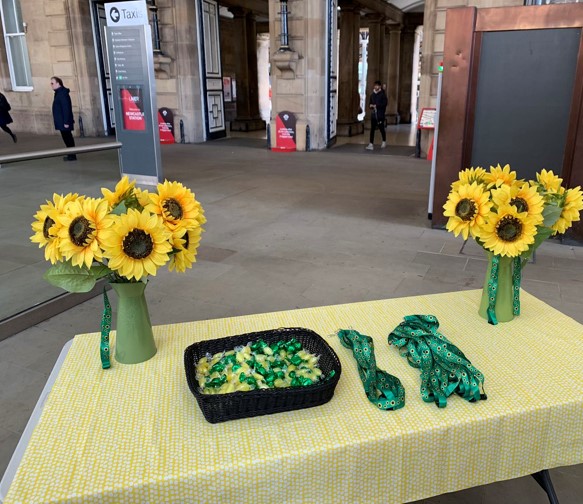
LNER has offered support to the RCA in launching sunflower lanyards at all racecourses
Working closely with Ascot’s CSR manager Jacqui Greet, Wales has worked hard to introduce the sunflower lanyard to the course’s hundreds of full and part-time staff.
“We have an ongoing process of training,” she explains. “It’s always difficult when you have high numbers of contracted staff, and turnover is higher than you might want it to be, because we employ a large number of students whom we may only see once. But we cover it off in our online training and all the information is in our documentation for stewards.
“We’ll be working to grow the training next year as we get towards Royal Ascot, where we employ about 6,000 people, from catering to car-parking staff.”
“For Royal Ascot 2020 we’re aiming to have a short accessibility module explaining what we are trying to do and the service we’re looking to provide. The objective is that all our customers have an enjoyable experience, allowing that the activity takes place outside on grass and with 70,000 people in attendance on Gold Cup day. There are always going to be challenges for those with additional needs, as well as for the able-bodied.”
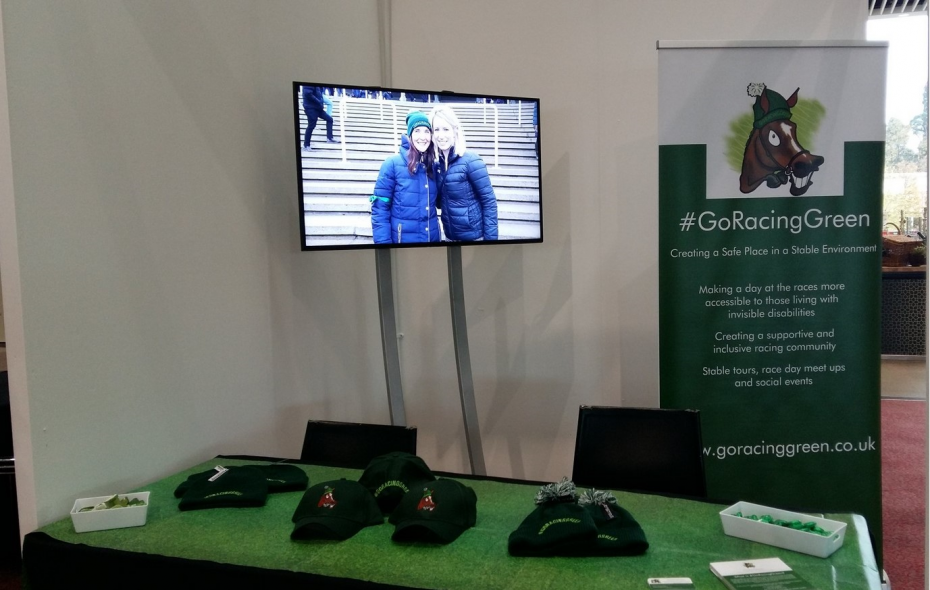
Debbie Matthews was exhibiting #GoRacingGreen during Ascot’s November meeting (image credit @NoviceFilly)
The next tangible evidence of Ascot’s drive to expand accessibility comes at this week’s two-day jumps meeting, with the launch of the Sunflower Lawn.
Wales explains: “It’s a smallish section by the pre-parade ring that will be quieter, so that anyone with social anxiety needs will be able to come for the first few races, enjoy the atmosphere and then go when they want. They’ll be able to do that without getting in the big melee of the crowds.
“It will be a non-alcohol area that caters for emotional and mental difficulties but is still near the horses. There will be other areas for people with wheelchair, sight or sound needs.
That’s why we keep coming back to the six types of disability. It’s very easy to get caught up in one type in which you may have a particular vested interest. We want to create spaces for everybody.”
Looking further ahead, Ascot’s accessibility working group, which Wales chairs and includes most heads of departments, has plans for a special room for use by those with hidden disabilities.
“But we’re not going to jump the gun,” she says. “We’re doing everything with considered, measured thought, to make sure we can deliver initiatives properly all year round.
“Everything we do is bound up in empowering our staff to deliver a unique experience for people who need them. It doesn’t have to cost a lot of money; it’s just about being a kind person.
“For instance, people who come in wheelchairs are often elderly, and their carers are their husband or wife, who might also be elderly and find it difficult pushing a chair for the whole day. So, we look out for them and brief our stewards in order that a member of staff can take over for a time, just to give the carer a break.
“Most of our experience so far has come from sheer common sense, being empathetic and kind, which is why the question is, ‘How can I help you?’
“It’s an easy cause to champion and a hard one to ignore.”